Wedding Craft Supplies: A Simple Starter Kit
The minimum kit for handmade wedding projects, what each tool does, which extras can wait, and a simple way to work out how much paper and ribbon to get for your guest count.
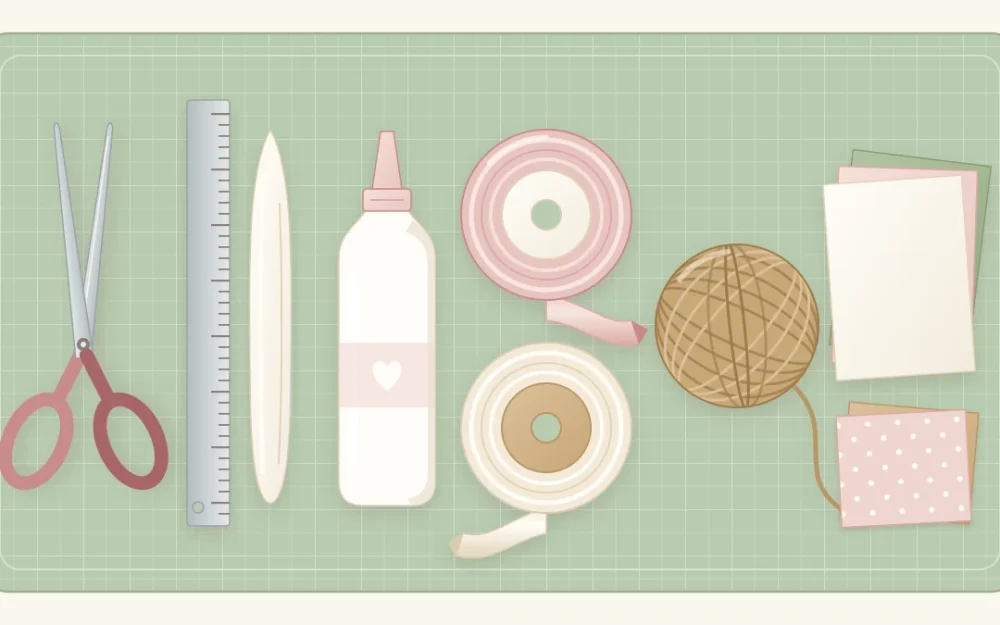
You can make most handmade wedding pieces with a kit that fits in one shoebox. The right wedding craft supplies are plain, sturdy basics: something to cut with, something to fold with, something to stick with, and a small stock of paper and ribbon.
Below is the minimum kit, what each item actually does, a few optional extras and a simple way to work out how much material to get for your own guest count. Everything is described by type, so you can use what you already own.
The starter kit at a glance
| Item | What it does |
|---|---|
| Sharp scissors | Cut paper, ribbon and twine cleanly |
| Paper trimmer | Makes fast, straight, repeatable cuts |
| Metal ruler and pencil | Measure, mark and guide straight lines |
| Bone folder | Scores fold lines and sharpens creases |
| Cardstock in two weights | Light for tags and layers, heavy for cards that stand |
| Ribbon and twine | Tie, wrap, hang and decorate |
| Hole punch | Makes neat holes for tags and garlands |
| Glue and tape | Join paper, ribbon and trims |
Cutting and measuring tools
Scissors. One sharp pair with blades about 8 in (20 cm) long handles nearly everything. If you can, keep a second pair only for ribbon and fabric, because paper dulls blades quickly and dull blades chew ribbon.
A paper trimmer. This is the tool that makes a batch of fifty cards look identical. You line the sheet up against a measuring guide and slide or lower the blade. For a beginner it is the easiest route to straight edges.
A craft knife, metal ruler and cutting mat. This trio does the same job as a trimmer and also cuts slots and inside corners. It is optional if you have a trimmer and scissors. If you do use a craft knife, always cut on a self-healing cutting mat against a metal ruler, never a plastic one.
Pencil and eraser. A sharp, hard pencil makes light marks that erase cleanly.
Safety note
With a craft knife, make several light passes instead of one hard one, keep the fingers of your holding hand behind the blade’s path, and cap or retract the blade every time you put it down.
Folding and punching tools
A bone folder is a smooth, blunt tool shaped a little like a letter opener. You run its tip along a ruler to score heavy paper, which means pressing a groove without cutting, and then use its flat side to press the fold sharp. An empty ballpoint pen can stand in for a first project. The full method is in the guide on how to cut and score cardstock for clean folds.
A single hole punch with a hole of about 1/8 to 1/4 in (3 to 6 mm) is enough for tags, garlands and anything that hangs from twine.
Paper, ribbon and twine
Cardstock in two weights. Light cardstock, about 65 lb, is easy to cut and fold and suits tags, layers and small shapes. Heavy cardstock, about 80 to 110 lb, is for anything that has to stand up or be handled: tent cards, table numbers and boxes. Buy both in the same two or three colors so pieces match.
Ribbon. Two widths cover most projects: a narrow ribbon of about 1/4 to 3/8 in (6 to 10 mm) for tying tags and bundles, and a wider one of about 1 1/2 in (4 cm) for bows and chair ties. Satin is smooth and dressy; grosgrain has a ribbed texture and holds a knot firmly.
Twine. Natural jute or cotton twine ties tags, wraps jars and carries garlands.
Glue and tape
Four adhesives handle nearly every job:
- White (PVA) glue for paper and cardstock. Use a thin coat; it dries clear.
- A glue stick for thin paper layers that wet glue would wrinkle.
- Double-sided tape for instant, flat, dry joins such as box seams and ribbon on a card.
- A low-temperature glue gun for bulky things that paper glue will not hold, such as faux flowers, lace on a jar or ribbon on wood.
White glue or double-sided tape is the default for paper. Treat the glue gun as the exception: even low-temperature hot glue and the metal nozzle can cause burns, so rest the gun on its stand, keep fingers away from fresh glue and work on a protected surface.
For help matching an adhesive to a material, see the guide to the best glue for each craft material.
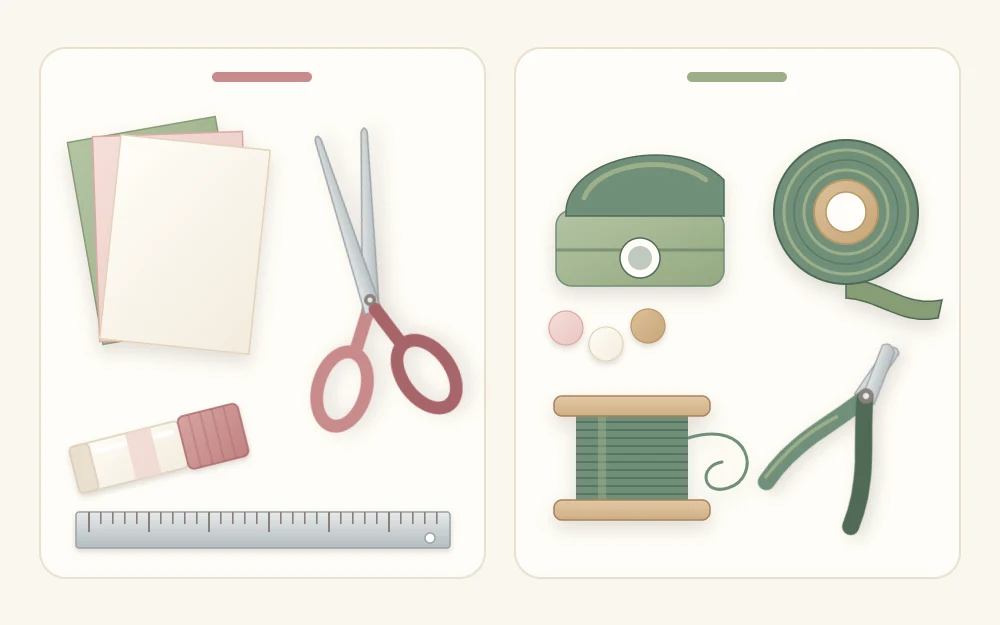
Optional extras worth adding later
None of these are needed on the first evening. Add them when a project calls for them.
- Shaped punches (circle, heart, scallop) for cutting many small identical shapes quickly.
- Floral wire and floral tape for binding greenery, building hoops and making boutonnieres.
- Wire cutters so your scissors are never used on wire.
- A fine-tip pen or paint pen for lettering names and numbers. Test it on a scrap of your actual paper first to check that it does not bleed or smear.
How much to buy for your guest count
Work out quantities before you shop, one project at a time.
- Count the pieces. For anything made per guest, take the guest count and add roughly ten percent as spares. For 80 guests that is 88 pieces.
- Work out pieces per sheet. Letter-size paper is 8 1/2 x 11 in. A tag of 2 x 3 1/2 in (5 x 9 cm) fits 12 to a sheet, in four columns and three rows. For 88 tags you need 8 sheets, so get 10.
- Add up ribbon and twine. Multiply the length for one piece by your count. A 12 in (30 cm) tie for each of 88 tags is 1,056 in, just under 30 yd (27 m).
Buy ribbon by the roll rather than in short cut lengths, and get all of one color at the same time. Shades can vary between batches, and a second roll bought later may not match.
If the counting feels like a lot, the overview of where to start with wedding crafts explains how to keep your project list short.
Storing supplies and finished pieces
Keep cardstock flat in its pack or between two pieces of cardboard so the corners stay crisp. Leave ribbon on its spool; loose ribbon creases.
Finished paper, ribbon and fabric pieces can wait for weeks if they are stored flat, dry and out of sunlight. Shallow lidded boxes work well. Label each box with what is inside and how many, so the final count takes minutes.
Frequently asked questions
Do I need a paper trimmer, or are scissors enough?
Scissors are enough for a small number of pieces if you cut along a ruled pencil line. A paper trimmer becomes worthwhile once you are making dozens of identical cards or tags, because it keeps every edge straight and every piece the same size with far less measuring.
What weight of cardstock should I get for wedding crafts?
Get two weights. Light cardstock, around 65 lb, is easy to cut and suits tags, layered shapes and garlands. Heavy cardstock, around 80 to 110 lb, is better for anything that stands or gets handled, such as tent place cards, table numbers and favor boxes.
How many spare pieces should I plan for?
Roughly ten percent on top of your count is a sensible margin for per-guest items, so about 88 pieces for 80 guests. The spares cover miscuts, smudged lettering and late changes. Buy materials for the larger number from the start so that everything comes from the same batch.